I don't know very much about Jo Smith, except that she is the Embroiderers Guild Scholar in the 30+ age group for 2012, which itself is no mean feat. This very prestigious organisation only award two scholarships a year, one for an 18-30 yrs category, and one for 30+ so it's a big deal, and in my opinion quite rightly awarded!
I found her stand at the 2012 Knitting & Stitching Show at Alexandra Palace, and fell in love with her work immediately; particularly her Kitten pieces.
Jo herself kindly provided me with these photographs.

Jo's Alexandra Palace stand


This Kitten Bed piece tells the story of three little kittens Jo and her family were due to adopt that were sadly so flea infested, that they died from the viruses the fleas introduced to their systems, and the dehydration effect of having their tiny bodies sucked dry before they were old enough for Jo and her family to take them home. The fleas literally 'sucked the life' out of the trio. The 3 tiny hospital style beds each have a tiny helpless kitten lying on them, depicted in incredibly expressive embroidery drawing, whilst the border, which appears to be a decorative pattern on first glance is actually made from a repeated image of the fleas that sucked the poor little babies dry.
It will be hard to see all of the incredible detail in Jo's hand embroidery from these pictures, but if you click on each image it will produce a larger version.

The piece that really made me fall in love with Jo's embroidery was this portrait of the three kittens. It is not until you look very closely at the delicate white on white embroidery on the vintage looking doily that you realise the background pattern is made from repeated images of tiny kitten skeletons.
I think I love it so much because it reminds me of my favourite Alexander Henry fabric 'Osteology' (incidentally I was wearing my handbag made from this fabric at Ally Pally). As an embroiderer myself, I worked with drawing in stitch at Art College and know the skill and patience required to get results like these.

Another amazing piece is this embroidered mouse picture, framed with tiny genuine mouse skulls, which Jo apparently extracted from Owl Pellets! I won't be asking Brian at Folkestone Owl Sanctuary for pellets any time soon, but it is certainly an interesting idea!


These two portraits commemorate beloved family pets 'Stripe' and 'Twitch', who despite numerous visits to the vets and the love and care of Jo's family passed away due to ill health some years ago. They were the Smith children's first experience of being carers for another living creature, so I think most of us can identify with their loss. I certainly clearly remember the love and loss of one of my earliest family pets, a giant grey lop rabbit called Benjamin.
You may think that these portraits of dead animals are a little 'tasteless', but I think that the charm of Jo's unique embroidery and presentation style, and the numerous hours and skill put into the work show the love and care taken with these pieces. These are not done to offend or distress the viewer, far from it, and the subtle and delicate medium takes the edge off any thoughts about revulsion or 'shock'. I didn't even think of these things when I first saw Jo's work, but am mentioning them now because I'm aware that not everyone reading my blog will have the same thoughts on the artwork as me. From my own work, I'd estimate some of these embroideries took between 30-50 hours to complete, and believe me when I tell you that you don't embark on an intricate and complicated endeavour like that unless you feel really, really strongly about the subject!
These are memorial pieces, showing the love and affection, and sense of loss for the family of these beautiful creatures. I have included Jo's Artists Statement at the bottom of the page, which should help explain further her thoughts and motives behind the artworks.

Another piece from the show that makes me positively squeal with admiration for the Artist is this sculptural piece of a tiny disemboweled mouse, apparently brought in by the family cat, and respectfully buried at the bottom of the garden beside the beloved rabbits. I can't explain why, I just love it. The fine line between 'cute' and 'macabre' just ticks all my boxes! I'd be much less happy to find a real dead mouse on my carpet, but as a cat owner I can appreciate the little 'gifts' that our beloved pets bring us.


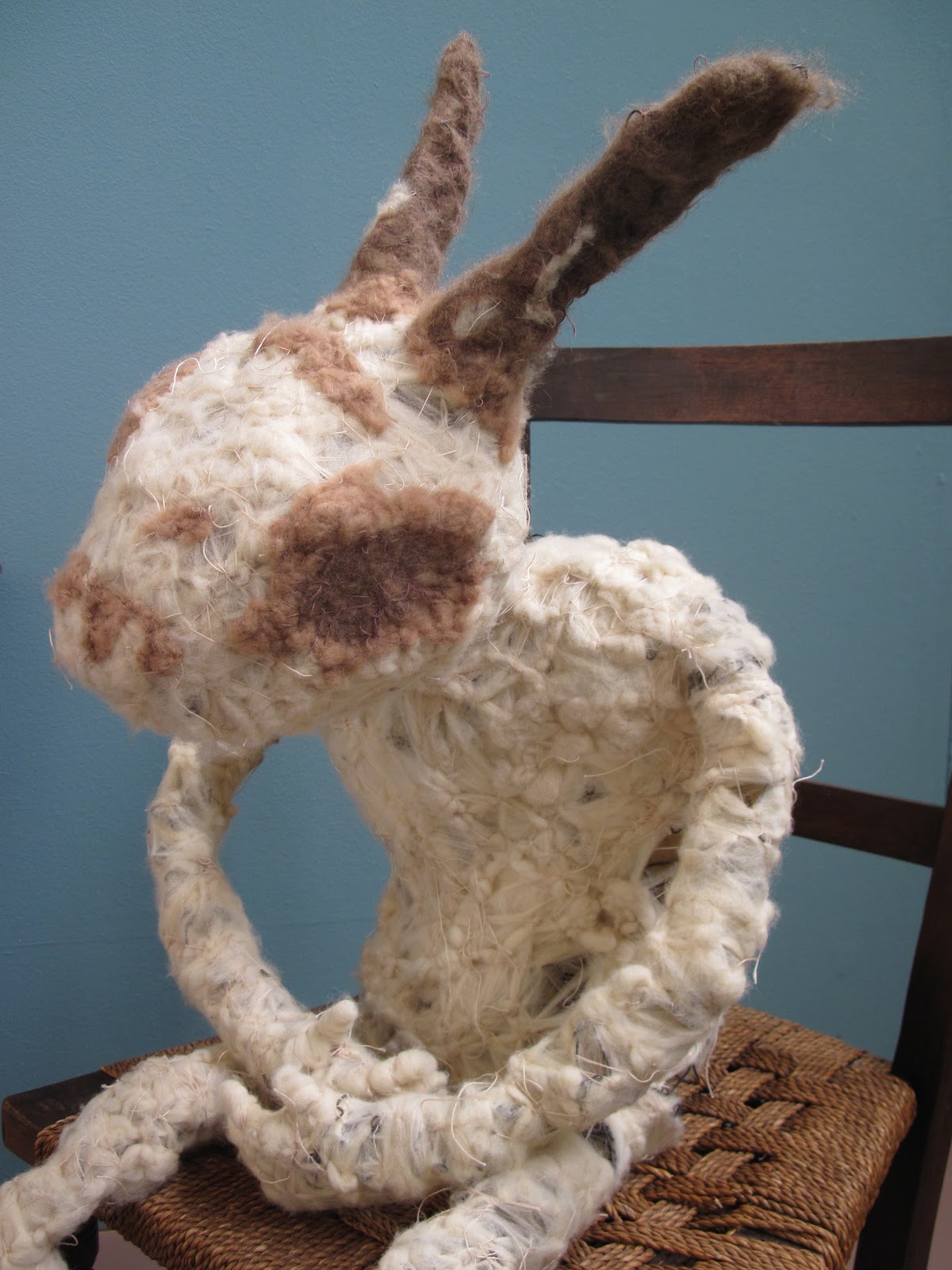


These last five pictures show beloved bunnies Twitch and Stripe as they battled the illness that killed them, and in Jo's words "wasted away before our very eyes".
To me, Jo's work captures and commemorates those tiny deaths that every family experience, but that go barely noticed in the rush and hustle of everyday life. These animals are portrayed carefully and lovingly, and Jo bestows them with the status that we would give the late Human family members whose photo's adorn our walls or mantelpieces. Memory and mourning entwine with a family's private moments to remind us just how precious and fleeting life really can be.
Artists Statement: Jo Smith
Two Brothers, Three Sisters and a Mouse
Small deaths in the domestic environment, this work tells the tale of the loss, sorrow and suffering of the animals buried beneath the foliage at the bottom of the garden. Two rabbits, three kittens and a mouse.
The rabbits were the first family pets we had and our children's first experience of being carers and guardians of another living creature, they were much loved and sadly missed. Losing the battle to ill health at the ages of just two and three years old, after numerous trips to the vets, they became gradually more and more ill. They wasted away before our very eyes; nothing could be done to save Twitch and Stripe.
The kittens were killed by fleas, victims of neglect at the hands of their carer, they were not properly looked after and their deaths were entirely preventable. They were due to come and live with us and just as they became old enough to leave their mother one by one they began to keel over and die, only one kitten out of a litter of five survived. We rescued one and rushed her to the vet; she survived overnight but died the next day, she is buried with her sisters.
The kittens were killed by fleas, victims of neglect at the hands of their carer, they were not properly looked after and their deaths were entirely preventable. They were due to come and live with us and just as they became old enough to leave their mother one by one they began to keel over and die, only one kitten out of a litter of five survived. We rescued one and rushed her to the vet; she survived overnight but died the next day, she is buried with her sisters.
The mouse, the victim of one of our cats, was dumped upon the carpet, terrified and injured and although we tried our best to save him he passed the next day and is buried alongside the rabbits.
The animal and human have here been merged. The rabbit sculptures have been constructed to the size of their human counterparts of the same age. There are portraits of the animals happy and healthy, as we would have pictures of our loved ones upon the walls, are here surrounded by bones. Chocolate box kitten faces stitched upon a delicate doily are encircled by skeletons, appearing alongside sculptures depicting the manner in which they passed.
The kittens dying in their sleep are here in beds surrounded by the fleas that killed them, the rabbits thin and wasting away, spines showing and the poor solitary frightened mouse is on the floor lost, alone and injured.
There is barely a home in the land that has not been touched by grief and sorrow at the loss of a loved one. If nothing else, death serves to remind us how precious life is, no matter how small.
There is barely a home in the land that has not been touched by grief and sorrow at the loss of a loved one. If nothing else, death serves to remind us how precious life is, no matter how small.
______________________________________________________________________
Update 01/11/12:
Jo now has a facebook page for her art here and a wordpress site here so follow/add her to keep up to date on news about work and exhibitions.
I'd like to dedicate this blog post to Ozzie the Bearded Dragon, Charlie the Chameleon and Moss the Guinea Pig.


